Download Free resource
Want help with LIDP? Download our free guide.
Our LIDP checklist will help you navigate the complexities that will assist you with successful completion.
Thank you for submitting the form. Window will open the PDF link now, click the button below if it doesn't.
Download resourceSocial procurement is no longer just a compliance exercise. It is now a key driver of inclusion, sustainability, skills and social value across the business sectors. Governments across Australia are using procurement to deliver more than goods and services. They are leveraging procurement to shape local economies, supporting diverse suppliers and improving community outcomes.
For businesses in construction, infrastructure and other major project industries, knowing these policies is essential. They shape how contracts are awarded and how success is measured.
Social Procurement Policy Mapping
At Sedo Group we have mapped these policies, so you do not have to. Use the accompanying map to see each state and territory’s key procurement priorities at a glance.
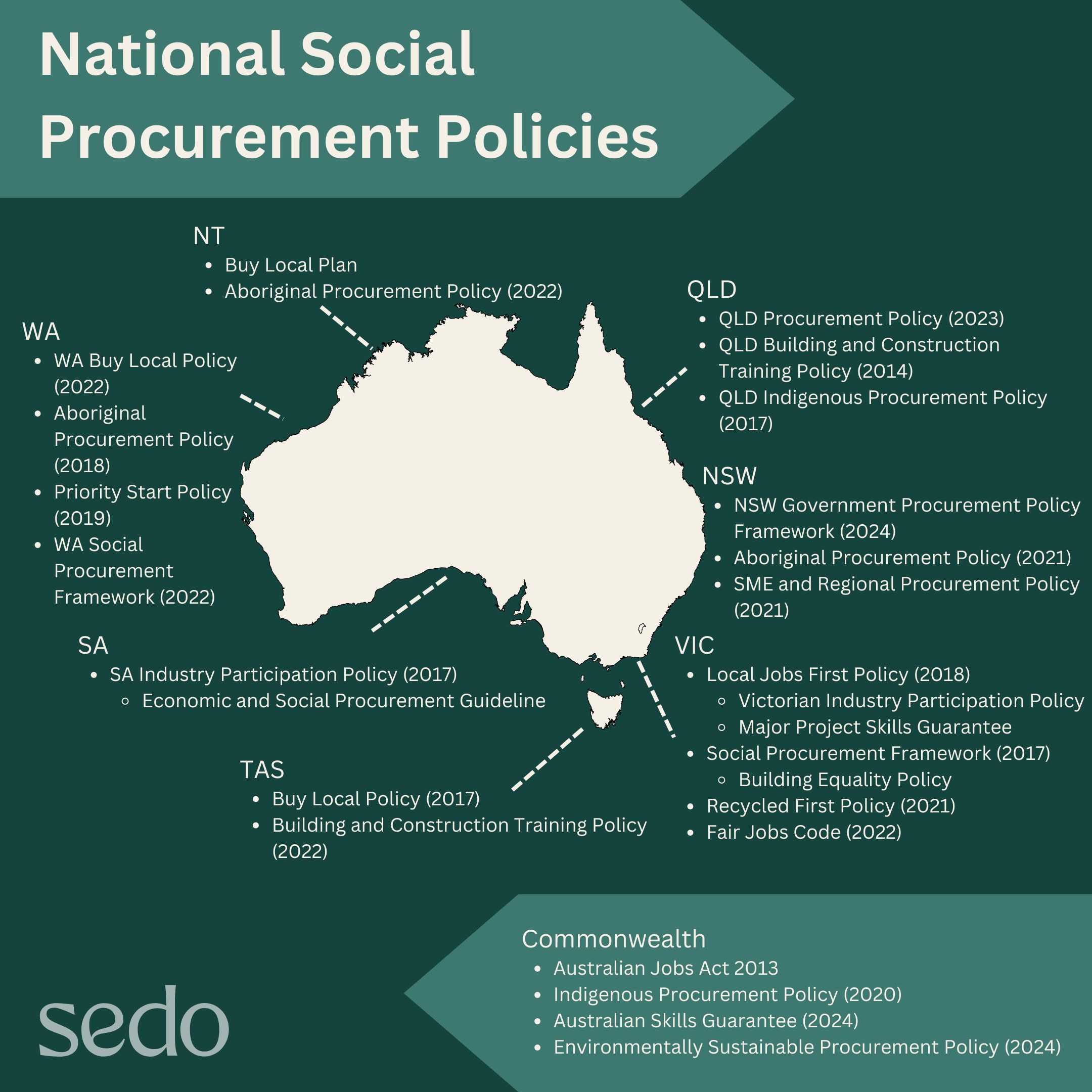
Map of social procurement policies
Victoria (VIC) – Social Procurement and Government Procurement Policy
Victoria is a long-standing leader in social procurement. Its policies are coordinated under a central framework that covers equality, sustainability and job creation.
- Local Jobs First Policy (2018), ensures local workers and suppliers benefit from Victorian state infrastructure projects
- Victorian Industry Participation Policy, promotes local industry engagement on government contracts
- Major Project Skills Guarantee, applies minimum targets for apprentice, trainee and cadet roles on strategic projects
- Social Procurement Framework (2017), builds social value into all procurement activity, which includes inclusive employment and social spend
- Building Equality Policy, supports gender equality in construction
- Recycled First Policy (2021), requires recycled and reused materials in major transport projects
- Fair Jobs Code (2022), sets workplace standards for suppliers seeking government contracts

Victorian Government Procurement Policy Framework

This approach shows how procurement can drive fairness, sustainability and diversity at scale. However, the extensive policy framework can create challenges in implementation.
Western Australia (WA) – Combining Procurement Policies
In 2020, WA introduced a Social Procurement Framework. Unlike Victoria, its framework combines several policies, each managed by different agencies and Departments. This makes it flexible but also means processes vary between sectors.

Western Australian Social Procurement Framework
- WA Social Procurement Framework (2022), guides integration of social, environmental and economic outcomes across sectors
- WA Buy Local Policy (2022), prioritises local suppliers to support WA’s economy
- Aboriginal Procurement Policy (2018), sets targets for awarding contracts to Aboriginal businesses
- Priority Start Policy (2019), requires apprenticeship and trainee hours on government projects
WA’s model delivers broad benefits but requires businesses to navigate more than one policy owner to achieve outcomes. The decentralised approach can often result in uncoordinated and unrealised impact.
Northern Territory (NT) – Procurement Policy Focused on Regional Development
NT uses procurement to support local business and strengthen Aboriginal economic participation.
- Buy Local Plan, encourages local industry participation to keep value in the Territory
- Aboriginal Procurement Policy (2022), increases contract opportunities for Aboriginal-owned businesses and organisations
This direct approach supports regional growth and cultural inclusion.
Queensland (QLD) – Social Enterprise and Skills Development
Queensland’s procurement policy requirements are increasing with maturity. There has been a strong focus to date on social enterprise activation as well as a focus on the Indigenous business sector and workforce training requirements.
- QLD Procurement Policy (2023), promotes ethical, sustainable and inclusive procurement
- QLD Building and Construction Training Policy (2014), ensures projects deliver workforce training
- QLD Indigenous Procurement Policy (2017), sets targets for Indigenous business participation
There is a strong foundation of procurement policy requirements that we expect to expand and grow as we welcome major projects in the area like the Olympics 2032.
New South Wales (NSW) – Regional and Social Procurement Policy

NSW Procurement Policy Framework
NSW has more recently modernised its government procurement policy framework to include strong social and regional priorities through the following documents:
- NSW Government Procurement Policy Framework (2024), sets principles for value, transparency and social benefit
- Aboriginal Procurement Policy (2021), increases opportunities for Aboriginal-owned businesses
- SME and Regional Procurement Policy (2021), boosts participation from small and regional suppliers
Transport for New South Wales projects are also applying additional requirements on major infrastructure projects that are championing strong social procurement practices, above and beyond the mandatory policies.
South Australia (SA) – Economic and Social Procurement Policy Focus
SA’s procurement approach boosts local industry and delivers community benefits. It follows a local and economic mandate as managed by the Office of the Industry Advocate.
- SA Industry Participation Policy (2017) encourages local suppliers and job creation and can be tailored to focus on Aboriginal participation.
- Skilling South Australia Procurement Guidelines aimed at increasing opportunities for apprentices and trainees on major projects.
- Economic and Social Procurement Guideline, helps agencies include social outcomes in procurement.
This ensures spending directly benefits the state’s economy and people.
Tasmania (TAS) – Local Supplier and Training Procurement Policy
Tasmania focuses on keeping economic value in the state while developing skills in construction.
- Buy Local Policy (2024), prioritises Tasmanian suppliers, particularly SMEs
- Building and Construction Training Policy (2022), requires training for the local workforce
This model supports both the economy and skill growth but does not yet focus on elements of diversity and inclusion through employment or spend requirements.
Commonwealth (National) – Federal Procurement Policy Leadership
Federal policies set the tone for procurement nationwide, especially in Indigenous engagement, skills and sustainability.
The Federal Government applies the following policy frameworks onto procurements

Federal Environmentally Sustainable Policy
- Australian Jobs Act (2013), promotes local industry participation in major projects
- Australian Industry Participation ensures major projects prioritise Australian businesses
- Indigenous Procurement Policy (2020), sets targets for Indigenous business participation
- Australian Skills Guarantee (2024), requires training on major government projects
- Environmentally Sustainable Procurement Policy (2024), embeds environmental considerations in procurement focused on circular economy principles.
The Commonwealth Framework pushes states and territories to be more inclusive, sustainable and skills-focused but does not have a strong mandate on their policy approaches.
For companies in sectors such as construction and infrastructure, aligning with these policies is a competitive necessity. Those who integrate social value into their operations will not only meet compliance requirements but also strengthen their reputation and impact.
If you’re keen to learn more about how these policies will impact you, reach out to us to learn more.
Frequently Asked Questions
Can Sedo Group help us with our tender response?
Absolutely. Sedo Group supports clients with bid writing, Local Industry Development Plans (LIDPs), and social value strategies. We help you articulate your impact clearly, meet government compliance requirements, and improve your success rate on tenders. Visit sedogroup.com.au to learn more.
What are the risks of not engaging in social procurement?
Without a clear social procurement approach, businesses risk missing out on tenders, falling short on ESG goals, and losing trust with government and community stakeholders. Inaction can also signal a lack of alignment with modern business values, something that matters to buyers, employees, and partners alike.
How do I start implementing a social procurement strategy?
Start by reviewing your current spend and supplier relationships through a social impact lens. Then set clear, measurable goals that reflect your values and align with relevant policies. Partnering with social enterprises and Indigenous businesses is a great place to begin. Our social procurement consultants can help you build a tailored roadmap from there.
What are examples of social procurement outcomes?
Examples include creating job pathways for people facing barriers to employment, partnering with Indigenous businesses or social enterprises, reducing carbon emissions, and reinvesting in local services. These outcomes are measurable and meaningful and they’re exactly what government buyers want to see.
How much weight do social and sustainable outcomes carry in government tenders?
We’ve seen tenders where up to 40% of the evaluation weighting is linked to social or sustainable outcomes. That’s a significant portion, and it reflects how government buyers are redefining value. Social procurement is no longer a bonus. It’s a core part of how tenders are assessed.
How does social procurement give my business a competitive advantage?
Social procurement helps your business stand out in competitive tenders by demonstrating your commitment to social value. Governments and buyers are actively looking for suppliers who contribute to inclusion, sustainability, and local economic development. It shows you understand the bigger picture and positions your business as a trusted partner.
How do I measure the impact of my social procurement activities?
You can measure impact by tracking spend with social or Indigenous suppliers, counting job outcomes, and evaluating local economic or environmental benefits. Sedo Group provides clear frameworks and templates to help you monitor, report, and communicate your impact to clients and stakeholders.
Is social procurement mandatory for private businesses?
While not always mandatory, social procurement is increasingly expected, especially when bidding for public sector work. Many agencies now require it as part of their tender criteria. Businesses that can demonstrate social impact will have a clear edge in today’s procurement landscape.
What policies drive social procurement in Australia?
Key policies include the Victorian Social Procurement Framework (SPF), Queensland’s Buy Queensland policy, the Indigenous Procurement Policy (IPP), and the Local Jobs First policy. These frameworks guide how social impact is built into procurement. Our social procurement consultants have deep experience helping clients align with all of them.
What’s the difference between social procurement and strategic procurement?
Strategic procurement focuses on aligning purchasing with commercial goals like cost efficiency, compliance, and risk reduction. Social procurement builds on this by embedding social value into the procurement process, ensuring that what you buy also benefits the community. At Sedo Group, our social and strategic procurement consultants help you combine both to maximise impact and results.
What is social procurement and why is it important?
Social procurement is when organisations use their purchasing power to create positive social, economic, and environmental outcomes. It’s important because it allows everyday spending to have a meaningful impact, such as supporting jobs, diversity, and stronger communities. It’s also increasingly a key factor in government tender evaluations.